Could Passage of Proposition 1 Affect the City’s Ability to Pay For Regular City Expenses?
The Quick Answer
The short answer is: Yes, quite possibly.
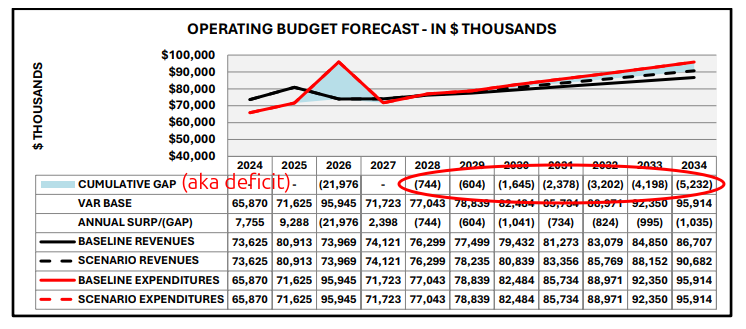
The City currently predicts that, starting in 2028, its projected revenue will be less than its projected expenses. Because of this, the City says it will be imperative for the voters to pass a Levy Lid Lift in 2028. Even with that, due to statutory limits on levy rate combined with the fact that levies are increasing faster than assessed values, the City believes it won't necessarily be able to raise its tax rate sufficiently to cover the expected budget deficit.
The new levy created by Prop 1 would count against the statutory levy rate limit and only make matters worse.
The Details
In the report generated by city staff for agenda item 9b at the September 14, 2026 city council meeting relating to the biennial budget, it states that starting in 2028 the city’s expenses will exceed its revenue and that the city is projecting that there will be a continuing budget deficit each year through 2034. The report also states that the anticipated six-year Levy Lid Lift the City will request voters to approve in 2028 won’t solve the problem because it cannot increase the tax rate sufficiently to cover the budget deficit. (The following figure is from the top of page 9 of the report.)
The Nitty-Gritty
That is all alarming enough. However, if Prop 1 passes creating a new Metropolitan Park District and authorizing it to collect taxes of up to $.75 per thousand of assessed valuation, it could further limit the city’s ability to raise the taxes needed to meet its expenses. This is IMPORTANT, but it is also complicated, so please bear with us and read further here as we try to explain.
First, some definitions. A tax levy is the amount of money (in dollars) collected by a tax. A tax levy rate is the rate or amount per thousand dollars of assessed value that is charged against a property and paid by the taxpayer. Washington State limits how much the regular tax levy amount can increase from year to year to 1%. This limit can be modified by a voter-approved Levy Lid Lift.
Washington also limits the tax levy rate a tax jurisdiction can impose for regular taxes. Cities cannot impose rates greater than $3.375 per thousand. Metropolitan Park Districts cannot impose rates greater than $.75 per thousand. There is also a combined limit that applies to counties, cities, and most all other junior taxing districts including metropolitan park districts that levy taxes against the same properties. All those jurisdictions’ rates in combination cannot exceed $5.90 per thousand. If they do add up to more than $5.90, they will each automatically be reduced under a complicated formula provided by statute.
The limit of 1% per year on the tax levy amount can be changed by voters through approval of a Levy Lid Lift. That is, voters can authorize a levy rate increase that results in a greater than 1% increase in the tax amount collected. However, voters cannot authorize a levy rate increase above the maximum levy rate imposed on the taxing jurisdiction. The $3.375 limit on the levy rate maximum for cities, the $.75 maximum rate for metropolitan park districts, and the $5.90 limit on the combination of county, city, and other junior taxing districts cannot be changed by voters.
Please note, as with all things tax-related, there are exceptions, exclusions, weird definitions (like what is and isn’t a regular levy) and a bunch of fine print. And fluctuations in assessed values within the taxing jurisdiction also impact tax levy rate limits and the levy amount collected at a particular tax levy rate. This is just intended to provide a general overview and understanding of how the various tax limitations work.
The city report for the September 14, 2026 council meeting that projects budget deficits through 2034 states that the city cannot use a levy lid lift to increase the current tax levy rate (from page 8 of the report):
It is also important to note that with our current, conservatively forecasted, property valuation increases, staff does not anticipate having rate capacity to do a ‘reset’ or ‘bump’ with the next levy lid lift, which is currently scheduled for November, 2028.
The report doesn’t explain if the city is already bumping up against the $3.375 city rate limit or if it is concerned about the $5.90 combined overall rate limit and whether the $.75 of MPD taxes is part of that consideration. In any event, the new MPD tax could take up a big share of the $5.90 maximum allowed levy rate for the combined county, city and the other junior taxing districts going forward and limit their ability to increase taxes for necessary services.
How does the city plan to cover the deficit? The MPD tax, if imposed, can only be used to fund MPD expenses and would not be available to cover the deficit for the City’s essential services. For 2028, the city says there will be a surplus from 2027 to pay the deficit. After that, here’s what the city says (from the bottom of page 7):
[…] continued economic uncertainty requires a cautious approach to revenue forecasting, with some forecasters anticipating the possibility of an economic downturn in 2027 or 2028. An economic downturn could negatively affect economically sensitive revenues and create budget pressures that require the City to reduce spending, delay or eliminate planned programs and services, leave positions vacant, or take other cost-containment measures.
So if Proposition 1 is approved, taxpayers could find themselves paying 33% more to the city than before and receiving far less in City programs and services.
Summary
The City, by its own projections, won’t be able to meet its existing expenses through 2032 and yet wants voters to vote in favor of the city taking on new $100 million in debt to build a pool facility. And the new taxes to support that debt may prevent the city from collecting the taxes it needs to pay for essential services.
This does not seem like a fiscally responsible plan.